
A water tower is easy to recognize but surprisingly easy to misunderstand. Most people assume it catches rain, filters water, or supplies an entire town without help from pumps. None of those descriptions is quite right.
A municipal water tower is an elevated storage tank connected to a pressurized drinking-water distribution system. Pumps move treated water into the tank, gravity pushes it back into the pipe network, and automated controls keep the water level and pressure within planned limits.
That arrangement gives a community three valuable things: steadier pressure, stored water for periods of high demand, and a reserve that may remain available during a pump or power interruption.
The shortest explanation of how a water tower works is this: treated water is pumped into a tank at a high elevation, where its weight creates pressure in the connected pipes. When customers use water faster than the pumps supply it, water flows out of the tank. When demand falls, pumps refill it.
The tower does not create water or clean raw water. Its job begins after the water has usually been treated and approved for distribution.
That simple gravity-fed system hides some careful engineering. Tank elevation, usable volume, pressure zones, pump settings, fire-flow requirements, pipe friction, local terrain, water age, disinfectant residuals, structural loads, and emergency planning all affect how well a tower performs.
This guide follows the complete journey—from the treatment plant to the elevated tank and finally to your faucet.
Quick Answer: How Does a Water Tower Work?
A water tower works through five basic steps:
- A treatment plant or well system produces finished drinking water.
- Electric pumps move that water into the distribution network and elevated tank.
- The elevation of the tank creates hydrostatic pressure.
- Water flows from the tower when system demand exceeds incoming pump flow.
- Level sensors and automated controls tell pumps when to refill the tank.
A tower therefore acts partly like a battery. A battery stores electrical energy for later use; a water tower stores gravitational potential energy in the form of elevated water.
The analogy is useful, though not perfect. The tower normally operates as part of a connected network of pumps, mains, valves, reservoirs, meters, hydrants, and control systems. It is rarely an isolated container feeding every customer directly.
What Is a Water Tower?
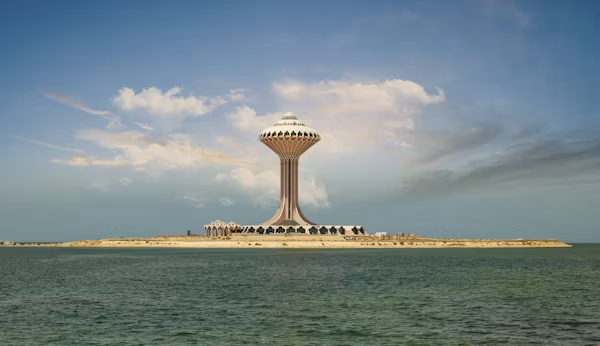
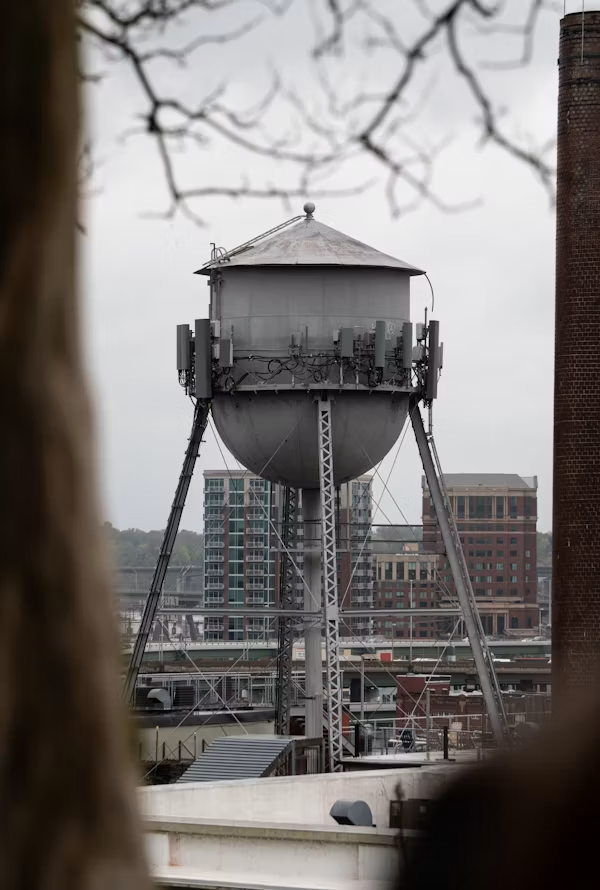
A water tower is an elevated structure supporting a tank that stores finished water. “Finished water” means water that has completed the required treatment process and is ready to enter the public distribution system.
The tank may sit on:
- A single steel pedestal
- Multiple steel legs
- A reinforced-concrete column
- A concrete shaft with an enclosed lower space
- A hill or other naturally elevated site
The term is often used loosely. Not every municipal storage structure is technically a tower. Utilities also use ground-level reservoirs, standpipes, hydropneumatic tanks, and partially buried storage facilities.
The defining feature of a traditional water tower is elevation. Raising the water creates pressure without requiring a pump to run every time someone opens a tap.
Main parts of a water tower
Although designs differ, a typical elevated water storage facility includes:
- A steel or concrete tank
- Structural legs, pedestal, or concrete support
- A foundation and anchor system
- Inlet and outlet piping
- Isolation and control valves
- An overflow pipe
- A drain
- A roof vent with protective screening
- A secured access hatch
- Interior and exterior ladders
- Water-level instruments
- Pressure sensors
- Electrical and communications equipment
- Interior and exterior protective coatings
- Cathodic protection on applicable steel structures
- Aviation warning equipment when required
- Security fencing and intrusion alarms
Some towers use one common pipe for filling and discharging. Others have separate inlet and outlet pipes to improve circulation or suit the distribution layout.
The Science Behind Water-Tower Pressure
The most important concept is hydrostatic pressure: pressure created by the weight of a stationary column of water.
The greater the vertical distance between the water surface and a point in the system, the greater the static pressure at that point. Pressure in a body of water is governed by the height of the water column rather than the tank’s shape. The USGS explains this same principle when describing how pressure is determined by the height of water above a measurement point. USGS guidance on water-column pressure
For water-system estimates: P≈0.433h
Where:
- P is pressure in pounds per square inch
- h is vertical water height in feet
The reverse calculation is: h≈2.31P
This means each foot of water elevation produces about 0.433 psi, while approximately 2.31 feet of water head produces 1 psi.
Pressure examples
| Vertical difference | Approximate static pressure |
|---|---|
| 50 feet | 21.7 psi |
| 75 feet | 32.5 psi |
| 100 feet | 43.3 psi |
| 120 feet | 52.0 psi |
| 150 feet | 65.0 psi |
| 200 feet | 86.6 psi |
Suppose the water surface in a tower is 140 feet above a house connection. Ignoring friction and other losses, the static pressure near that house would be: 140×0.433=60.6 psi
The amount of water in the tank matters because it changes the water-surface elevation. As the tank drains, the surface falls and pressure declines slightly. That pressure change is one reason utilities operate tanks within a planned range instead of allowing them to move continually from completely full to completely empty.
Why tank shape does not determine pressure
A million-gallon tank does not automatically produce more pressure than a 100,000-gallon tank.
If their water surfaces are at the same elevation, they create approximately the same static pressure at the same ground location. The larger tank stores more volume and can support demand for longer, but its pressure advantage comes only from elevation.
This is a common point of confusion:
- Height primarily determines static pressure.
- Tank dimensions primarily determine storage capacity.
- Pipe sizes and flow rates influence pressure loss.
- Pumps influence filling and operating conditions.
- Local terrain determines how much elevation remains between the tower and each customer.
How Water Reaches the Tower
Before entering a municipal tower, water usually travels through several stages.
1. Water is collected from a source
A public supply may obtain raw water from:
- A river
- A lake
- A reservoir
- An aquifer
- Municipal wells
- A combination of surface water and groundwater
The source determines the treatment challenges. River water may carry sediment and changing organic matter. Groundwater may contain dissolved minerals, iron, manganese, hardness, or other local constituents.
2. The water is treated
Treatment varies by source and regulation, but a surface-water plant commonly uses processes such as:
- Screening
- Coagulation
- Flocculation
- Sedimentation
- Filtration
- Disinfection
- Corrosion control
- pH adjustment
A groundwater system may need fewer processes or may use aeration, filtration, softening, contaminant-specific treatment, and disinfection.
The water tower is not normally the treatment plant. By the time water reaches it, the water should already meet applicable drinking-water requirements.
3. High-service pumps move finished water
Pumps send treated water from the plant, clearwell, or pumping station into transmission and distribution mains. Depending on system configuration, that flow may serve customers and fill the tower at the same time.
Water does not necessarily travel through the tank before reaching every home. In many systems, pumps, customers, and the tower all connect to the same network. The direction of flow changes as demand and pressure change.
4. The tank level rises
During low-demand periods—often late at night—pump production may exceed customer consumption. The excess water enters the tank and raises its level.
When the tank reaches its upper operating setpoint, the control system may stop a pump, reduce pump speed, close a control valve, or redirect flow.
What Happens When the Community Uses Water?
Demand rarely stays constant.
A town may use relatively little water at 3 a.m., then experience a sharp rise when people wake, shower, prepare breakfast, operate businesses, and begin school or industrial activities.
During a peak-use period, system demand may exceed the flow supplied by operating pumps. The pressure balance changes, and stored water leaves the tower to supplement pump output.
This process is called equalization storage. The tank helps equalize the difference between a comparatively steady production rate and a fluctuating consumption rate.
Later, when demand falls below production, the tank refills.
A simplified 24-hour cycle
| Time period | Typical demand | Likely tower response |
|---|---|---|
| Overnight | Low | Tank refills |
| Early morning | Rapidly rising | Tank begins supplying water |
| Midday | Moderate or variable | Level may stabilize or decline |
| Evening | Second demand peak | Tank supplies part of demand |
| Late night | Falling | Pumps restore tank level |
The exact pattern depends on climate, land use, industry, irrigation, tourism, population, and operating strategy.
A farming community may have strong seasonal irrigation demand. A coastal tourist town may experience major summer peaks. An industrial customer may draw large volumes during a particular shift. Engineers use actual flow records rather than assuming every community follows the same curve.
Pressure Zones: Why One Tower Cannot Always Serve an Entire City
Real cities are not flat. Their streets may run from a river valley to hills hundreds of feet higher.
If one tower served every elevation, customers in the valley could receive excessive pressure while properties on the hills received weak pressure. Utilities address this by dividing the distribution network into pressure zones.
Each zone may have its own:
- Elevated storage tank
- Ground reservoir and booster station
- Pumping facilities
- Pressure-reducing valves
- Pressure-sustaining valves
- Control points
- Emergency connections
A tower must be matched to the hydraulic grade line of its zone. The hydraulic grade line represents the energy level that determines pressure throughout that part of the system.
Why topography changes household pressure
Imagine a tower with a normal water-surface elevation of 650 feet above sea level.
- House A sits at elevation 510 feet.
- House B sits at elevation 590 feet.
Ignoring losses, House A has 140 feet of elevation difference, producing about 60.6 psi. House B has only 60 feet, producing about 26 psi.
Both houses are connected to the same elevated water surface, yet their pressure is very different. That is why high neighborhoods often need booster pumping or a separate higher pressure zone.
Low neighborhoods may need pressure-reducing valves to keep pressure from becoming excessive.
What Does the Tower Store Water For?
The useful capacity of a municipal tank is not treated as one undifferentiated pool. Engineers assess several storage needs.
Equalization storage
This is the volume used to balance normal daily swings between production and consumption. It fills during low demand and drains during high demand.
Fire storage
Firefighting can create a large, sudden demand. Hydrants may need to supply high flow while ordinary customers continue using water.
A tower can provide part of the required fire reserve, but available fire flow depends on more than tank capacity. Water-main diameter, network layout, valve position, pump capacity, residual pressure, hydrant condition, and the location of the fire all matter.
A large volume stored miles away behind undersized mains may not deliver the desired flow at a particular hydrant.
Emergency storage
Emergency volume can support the system during:
- A power failure
- Pump breakdown
- Treatment interruption
- Transmission-main break
- Well outage
- Source-water problem
- Planned maintenance
Stored water buys response time. It does not guarantee uninterrupted service through every emergency. A major main break, prolonged outage, contamination event, or extreme fire demand may exhaust or isolate the available supply.
Operational storage
Utilities need enough usable range to start and stop pumps efficiently, maintain target pressure, and control turnover. Pumping too frequently can increase wear, while oversized operating ranges can produce larger pressure changes.
Inactive or unavailable volume
Not every gallon in a tank is hydraulically usable.
Water below an outlet elevation may be inaccessible during normal operation. Some volume may need to remain in the tank for structural, water-quality, or operational reasons. A utility therefore distinguishes nominal tank volume from usable storage.
Why Water Towers Save Energy
Without elevated storage, pumps would have to respond more directly to every change in water use. A sudden demand spike could require several pumps to start quickly, while a low-demand period might leave large pumps operating inefficiently.
A tower allows a utility to produce and pump water in a more controlled pattern. Pumps can fill storage during lower-demand periods and, where electricity pricing supports it, during less expensive hours.
Variable-frequency drives now allow pump motors to change speed, making direct pressure control more practical than it once was. Even so, elevated storage remains valuable because it provides physical reserve and can continue producing pressure without an operating motor.
The best arrangement depends on system size, terrain, energy tariffs, emergency requirements, and existing infrastructure.
What Controls Filling and Draining?
Modern towers are commonly monitored through supervisory control and data acquisition, known as SCADA.
Level sensors report the water elevation in the tank. Pressure transmitters measure conditions at important network points. Flow meters record water entering or leaving facilities. Programmable logic controllers apply operating rules, while SCADA software displays the system to utility operators.
A simplified control sequence might look like this:
- Tank level falls to a lower setpoint.
- The control system starts a designated pump.
- Water production exceeds current demand.
- The tank begins filling.
- Level reaches an upper setpoint.
- The pump stops or changes operating mode.
Real controls are more involved. Operators may account for:
- Time of day
- Electricity price
- Tank turnover
- Well capacity
- Treatment limitations
- Pressure at remote locations
- Forecast demand
- Pump efficiency
- Fire events
- Alarms and equipment status
Redundant sensors and independent high-level alarms may be used because an incorrect reading can cause serious trouble.
If filling continues after the tank is full, water should discharge through an overflow system rather than overload the vessel. An overflow event still demands investigation because it wastes treated water and may expose the facility to sanitary or erosion concerns.
Does a Water Tower Work During a Power Outage?
Usually, it can continue supplying water for a limited time—provided the tank contains water and the distribution system remains intact.
Gravity does not need electricity. Once water is elevated, it can flow toward lower-pressure parts of the network.
The duration depends on:
- Water level at the start of the outage
- Tank’s usable volume
- Community demand
- Number of active leaks
- Fire demand
- Elevation of customers
- Pipe and valve configuration
- Availability of generators
- Ability to continue treatment and pumping
The tower is a buffer, not an endless backup. If pumps cannot run, the water level falls as customers consume the stored supply. Pressure declines with it.
Critical stations often have standby generators, alternate electrical feeds, mobile generator connections, or multiple pumps. Emergency planning also considers fuel availability and the time required to restore power.
Does the Same Pipe Fill and Empty the Tank?
Sometimes.
A common-pipe design uses one riser for filling and withdrawal. Flow changes direction according to system conditions. This configuration can be economical, but tank geometry and operating range must still promote adequate mixing.
Separate inlet and outlet pipes can guide water through more of the tank. Designers may place inlets, outlets, diffusers, or mixing equipment to reduce stagnant areas.
The best configuration depends on tank shape, turnover, water chemistry, disinfectant strategy, flow patterns, and the distribution system.
Water Quality Inside a Tower
Storage improves hydraulic reliability, but poorly designed or poorly operated storage can create water-quality problems.
The EPA identifies inspection, cleaning, pressure management, and finished-water storage operation as important parts of distribution-system water quality. Its guidance notes that pressure must be managed under changing demand conditions and that tank operation should be coordinated with the wider pressure zone. EPA distribution-system tools and guidance
Water age
Water age is the time water spends in treatment and distribution infrastructure before reaching a customer.
If a tank is far larger than the volume routinely exchanged, some water may remain in storage too long. Excessive age can contribute to:
- Disinfectant decay
- Taste and odor complaints
- Temperature increases
- Sediment accumulation
- Microbial growth conditions
- Changes in disinfection by-products
- Corrosion-related changes
The answer is not simply to keep every tank full at all times. Operators must balance emergency reserve against healthy turnover.
Mixing and short-circuiting
Water entering a tank can sometimes travel toward the outlet without mixing evenly with the existing volume. Other areas may receive very little circulation.
Thermal stratification can also form layers, especially in large tanks exposed to strong seasonal temperature changes.
Utilities can improve mixing through:
- Better inlet and outlet placement
- Passive mixing devices
- Mechanical mixers
- Managed operating levels
- Modified fill-and-draw cycles
- Recirculation systems
Disinfectant residual
Utilities monitor disinfectant residual because chlorine or chloramine can decline as water ages and reacts with pipe walls, sediment, organic matter, and biofilms.
A low residual is not automatically proof that water is unsafe, but it is a warning requiring investigation within the utility’s regulatory and operational framework.
Sediment
Small particles may settle at the bottom of a storage tank. Sediment can contain corrosion products, minerals, or material carried through the distribution network.
Routine condition assessment helps a utility decide when cleaning is needed. Cleaning frequency should be based on inspection findings and water-quality conditions rather than an arbitrary assumption that every tank requires identical treatment.
How Water Towers Are Inspected and Maintained
A tower may look motionless from the street, but it is an active piece of public infrastructure.
Inspection programs commonly assess:
- Interior coating condition
- Exterior coating condition
- Corrosion
- Welds and structural members
- Concrete cracking
- Roof and hatch condition
- Vent screening
- Overflow protection
- Foundation settlement
- Pipe condition
- Leakage
- Ladders and fall-protection equipment
- Instrumentation
- Security
- Sanitary integrity
- Sediment accumulation
The EPA provides guidance specifically addressing inspection and cleaning of finished-water storage facilities because defects can affect both reliability and water quality. EPA finished-water storage resources
Protective coatings
Water, oxygen, disinfectants, temperature variation, and weather can corrode unprotected steel. Specialized coatings isolate the metal from these exposures.
Interior coating materials used in contact with drinking water must be suitable for potable-water service. Exterior systems must resist sunlight, moisture, temperature changes, and environmental pollutants.
Coating failure may appear as blistering, rust staining, peeling, underfilm corrosion, or exposed substrate.
Cathodic protection
Some steel tanks use cathodic protection to reduce electrochemical corrosion. Sacrificial anodes or impressed-current systems alter the corrosion process so that protected steel deteriorates more slowly.
Cathodic protection complements good coatings; it is not a substitute for inspection.
Cleaning and disinfection
A tank may be drained for cleaning, repairs, or coating work. Before it returns to service, the utility follows applicable procedures for cleaning, disinfection, flushing, sampling, and clearance.
Taking a tank offline also changes system hydraulics. Operators may need temporary pumping arrangements, alternate storage, interconnections, or carefully scheduled work to preserve pressure and fire protection.
What Happens If a Water Tower Fails?
“Failure” covers many situations, from a faulty sensor to major structural damage.
Pump failure
The tower begins supplying stored water. Operators start another pump, use a backup station, deploy emergency power, or shift flow from another zone.
Main break
A large break can drain storage rapidly and reduce pressure. Crews isolate the damaged section with valves. Customers may experience interruption, discoloration, or a boil-water advisory depending on the event and local requirements.
Low-pressure event
Low pressure matters because it weakens service and can permit contaminants to enter through pipe defects under unfavorable conditions.
An EPA regional publication describes pressure below 20 psi as a pressure-loss condition in the context of public-water-supply response guidance and warns that contamination may enter during pressure loss. Exact operating and notification requirements depend on the responsible jurisdiction. EPA pressure-loss guidance
Overflow
An overflow may result from a level-sensor fault, control failure, stuck valve, communication problem, or operator error. The overflow pipe directs excess water away from the tank, but continued discharge can waste water and damage nearby soil.
Contamination concern
Possible contamination can result from an unsecured hatch, damaged vent screen, animal entry, flooding, loss of pressure, cross-connection, vandalism, or poor maintenance.
The utility may isolate the facility, collect samples, disinfect affected components, issue public instructions, or place alternate supplies into service.
Structural failure
Severe corrosion, foundation problems, extreme wind, earthquake, poor construction, ice loading, or neglected deterioration can threaten structural integrity.
Such failures are uncommon relative to ordinary operating problems, but their consequences justify professional inspection and engineering review.
Common Types of Water Towers and Storage Tanks
| Type | Basic form | Typical advantage | Important consideration |
|---|---|---|---|
| Multi-column elevated tank | Bowl supported by several legs | Familiar design and accessible structural members | Large exposed support structure |
| Pedestal tank | Tank on a single steel pedestal | Clean profile and enclosed riser | Interior pedestal access and ventilation |
| Composite elevated tank | Steel bowl on concrete pedestal | Large capacity and durable support | Complex construction |
| Standpipe | Tall cylindrical tank at ground level | Simple footprint and useful elevation | Only upper water may provide desired pressure |
| Ground reservoir | Tank at or near ground level | Large, economical storage volume | Usually needs pumps for pressure |
| Hydropneumatic tank | Water and compressed air in a pressure vessel | Useful for small systems | Limited storage compared with towers |
Why standpipes can be deceptive
A tall standpipe may contain a large volume, but the lower part does not necessarily provide adequate distribution pressure.
If acceptable service requires the water surface to remain above a certain elevation, only the water above that point is effectively usable under normal gravity conditions. This difference between total storage and useful pressure storage is important during planning.
Why Are Some Water Towers Shaped Like Spheres?
A spherical or spheroid tank distributes structural stresses efficiently and provides a high ratio of volume to surface area. Rounded shapes also avoid sharp corners where stresses can concentrate.
Not every tower uses a true sphere. Common profiles include:
- Spheres
- Spheroids
- Ellipsoids
- Conical-bottom bowls
- Fluted columns
- Cylindrical tanks
- Composite bowls
Structural efficiency is only part of the decision. Fabrication method, capacity, aesthetics, wind loading, inspection access, construction cost, foundation conditions, and local preferences also influence tower shape.
How Big Is a Water Tower?
There is no universal size. Elevated tanks can range from relatively small community facilities to tanks holding more than a million gallons.
Capacity is selected through engineering analysis rather than population alone. The analysis considers:
- Daily and peak-hour demand
- Required fire flow and duration
- Source and pump capacity
- Emergency objectives
- Number of pressure zones
- Industrial demand
- Future development
- Tank operating range
- Water turnover
- Reliability targets
- Distribution-system modeling
A tank that is too small may provide inadequate equalization or emergency reserve. A tank that is too large may raise costs and create water-age problems if the system cannot turn over its contents properly.
For a current real-world example, an EPA environmental assessment described a proposed 500,000-gallon elevated tank intended to improve both volume and pressure in Seminole, Oklahoma. EPA project assessment
Can a Water Tower Supply Fire Hydrants?
Yes, but the tower is only one part of the answer.
When firefighters open a hydrant, water may come from:
- Elevated storage
- Operating distribution pumps
- Ground reservoirs through booster pumps
- Interconnected pressure zones
- Neighboring utility connections
The achievable hydrant flow depends on the complete hydraulic path.
A tower with abundant storage cannot overcome a severely restricted main. Likewise, a large pipe network cannot sustain a long fire flow if sources and storage are inadequate.
Engineers evaluate both flow and residual pressure. They also examine whether ordinary domestic service can continue during the modeled event.
Why Don’t Tall Buildings Rely Only on the City Tower?
City pressure may be enough for lower floors but insufficient to lift water to the top of a high-rise.
Buildings commonly use:
- Booster pumps
- Break tanks
- Rooftop tanks
- Intermediate pressure zones
- Pressure-reducing valves
- Dedicated fire pumps
A tall building is effectively its own vertical distribution system. Its plumbing engineers must prevent low pressure on upper floors and excessive pressure on lower floors.
The city water tower establishes pressure in the public main; the building then manages pressure above the service connection.
Myths About Water Towers
Myth 1: The tower collects rainwater
Most municipal towers store treated water pumped from a plant or well system. Rain landing on the roof is kept outside the potable-water compartment.
Myth 2: The tower filters water
Treatment usually takes place before storage. The tower’s main jobs are pressure regulation and storage.
Myth 3: Water goes straight from the tower to every faucet
Flow paths constantly change. A customer may receive water pushed by pumps, supplied from storage, or blended from several sources.
Myth 4: A bigger tank always means higher pressure
Elevation creates static pressure. Capacity determines how much water is available.
Myth 5: The tank must be completely full to work
Towers operate between selected upper and lower levels. The water surface can move while remaining high enough to maintain the planned pressure.
Myth 6: Water towers make pumps unnecessary
Pumps are needed to lift water and restore storage. The tower reduces the need for pumps to respond instantly to each demand change.
Myth 7: A tower guarantees water throughout any blackout
It supplies a finite reserve. A long outage can eventually drain the usable volume unless pumping resumes.
A Practical Case Study: Morning Demand in a Small Town
Consider a simplified town with:
- 8,000 residents
- One elevated tank
- A normal operating capacity of 500,000 gallons
- Two high-service pumps
- A water surface about 130 feet above the central service area
At 4 a.m., the town uses 250 gallons per minute, while one pump supplies 600 gallons per minute. The excess 350 gallons per minute flows toward the tank.
At 7 a.m., demand rises to 1,050 gallons per minute. The operating pump still supplies 600 gallons per minute, so approximately 450 gallons per minute must come from storage or another pump.
If the first pump alone remained active for one hour under those simplified conditions, the tank would supply: 450×60=27,000 gallons
The system may then start a second pump as the tank reaches a setpoint or as pressure changes.
This example shows why tank capacity cannot be chosen using average daily consumption alone. The engineer needs the timing and intensity of demand, pump availability, fire-flow needs, emergency reserve, and hydraulic limitations.
It also shows why a tank does not merely “empty into town.” Pumps and storage share the load.
A Deeper Insight: The Tower Controls an Energy Level, Not Just a Volume
The most useful mental model is to stop picturing the tower as a bucket and start viewing it as a device that maintains the system’s hydraulic grade.
A utility cares about gallons, but customers experience pressure. Pressure depends on elevation, demand, pipe resistance, pump operation, and the water level in storage.
This explains several otherwise confusing facts:
- A tower can influence pressure even when little water is moving through it.
- Two equally sized towers at different elevations do not provide the same pressure.
- A full tank may still provide poor service to a neighborhood on a higher hill.
- A partly drained tank can continue providing acceptable pressure.
- A distant tank may have limited ability to support a fire if connecting mains are restrictive.
- A large tank can harm water quality if its operating pattern creates excessive water age.
The second useful answer to how a water tower works is therefore that it holds the hydraulic energy level of a pressure zone within a planned range while storing water for demand changes and emergencies.
What Utility Operators Watch Every Day
Operators do not judge the system merely by looking at the tower.
They monitor:
- Tank level trends
- Pressure at critical locations
- Pump status
- Pump discharge flow
- Well and treatment production
- Disinfectant residual
- Turbidity where applicable
- Tank turnover
- Unusual night flow
- Valve status
- Power conditions
- Communications alarms
- Overflow or intrusion alarms
A sudden drop in tank level could indicate high demand, firefighting, a large leak, a main break, a control error, or inaccurate instrumentation.
An unusual overnight decline is often especially informative because legitimate customer demand is normally lower. Utilities may compare minimum-night flow with historical patterns to identify leakage.
Advice for Residents Near a Water Tower
Residents generally do not need to operate or maintain a public tower, but a few observations can be useful.
Contact the water utility if you notice:
- Water flowing continuously from the overflow
- A visible leak from the tank or riser
- An open or damaged security gate
- Unauthorized climbing
- New rust streaks or falling coating debris
- Persistent major pressure changes
- Discolored, unusual-smelling, or unusual-tasting water
- Construction damage near tower piping
Do not enter the site, climb the structure, operate a valve, or attempt a repair. Elevated tanks are confined-space, fall, electrical, structural, and public-health environments.
If water quality changes suddenly, follow the utility’s instructions. Running a tap may help in some ordinary discoloration cases, but it is not the right response to every event—particularly if officials issue a do-not-use or boil-water notice.
Frequently Asked Questions
How does a water tower create water pressure?
The vertical distance between the tower’s water surface and the customer creates hydrostatic pressure. Each foot of elevation produces approximately 0.433 psi before accounting for friction and flow losses.
Does a water tower use electricity?
Gravity-driven discharge does not require electricity. Pumps, level sensors, control systems, communications equipment, lighting, mixers, and other supporting equipment generally do.
Is the water inside a water tower already clean?
Municipal towers normally store finished drinking water that has already undergone required treatment. The storage facility must still be protected, inspected, operated, and maintained to preserve water quality.
How does water get to the top of a tower?
Electric pumps create enough pressure to lift treated water through piping into the elevated tank.
Does water circulate inside a tower?
It should exchange and mix as the tank fills and drains, but circulation is not automatically uniform. Tank configuration, inlet momentum, temperature, operating range, and mixing equipment influence circulation.
Why are water towers placed on hills?
Natural elevation reduces the structural height required to achieve a target hydraulic grade. In some locations, a ground tank on a hill can provide the pressure that would require a tall tower on lower land.
Can a water tower freeze?
Freezing is possible in cold climates, especially around exposed piping or poorly circulating areas. Tank volume, heat retained by incoming water, insulation, circulation, operating patterns, and local design practices help manage the risk.
How long can a tower supply a town?
There is no fixed duration. Divide usable storage by the net rate at which water is leaving the tank. Demand, pump availability, leaks, fire use, and minimum pressure requirements all affect the result.
Why is my water pressure lower during busy hours?
High flow increases friction loss in water mains and service pipes. The tank level may also be lower during peak demand. Local restrictions, elevation, valves, or building plumbing can contribute.
Can a water tower overflow?
Yes. Level-sensor, valve, communication, control, or operator problems can cause overfilling. A properly arranged overflow system provides a controlled discharge path, but the event still requires correction.
Are water towers cleaned?
Utilities inspect storage facilities and clean them when condition assessments, sediment levels, operational history, or water-quality findings indicate a need.
Why do towns paint their names on water towers?
The broad tank surface is a visible landmark. Municipal branding has no hydraulic function, although exterior coating does protect the structure from corrosion and weather.
Can one tower serve several neighborhoods?
Yes, if those neighborhoods lie within a compatible pressure zone and the connecting mains can deliver the required flow. Large elevation differences may require separate zones.
Are rooftop tanks the same as municipal water towers?
They use the same gravity principle, but rooftop tanks are part of a building’s plumbing system. Municipal towers support a public distribution network.
What happens when the tank becomes empty?
Pressure may fall sharply unless pumps or another storage facility can maintain service. Utilities use alarms, operating reserves, backup equipment, and emergency procedures to prevent an uncontrolled empty-tank condition.
Final Takeaway
A water tower is a carefully positioned energy-storage and pressure-management device. Pumps lift treated water when capacity is available. The elevated tank stores that water, gravity returns it when demand rises, and automated controls repeat the cycle.
Its performance depends on far more than visible height. Useful capacity, elevation, terrain, pipe resistance, pressure zones, fire-flow requirements, turnover, water chemistry, maintenance, control logic, and emergency power must all work together.
That is why an old-looking tower can remain highly valuable. Its underlying principle is simple physics, yet it continues to solve a modern infrastructure problem: providing steady pressure and immediately available water without forcing pumps to chase every change in demand.